


-
-
미국 영상의학회지 Reliability of Computer-Assisted Breast Density Estimation: Comparison of Interactive Thresholding, Semiautomated, and Fully Automated Methods 2016.07.10.American Journal of Roentgenology. 2016;207: 126-134. 10.2214 논문 보기Materials and MethodsCraniocaudal mammograms of 100 healthy subjects were collected from a screening mammography databa
se. Three expert readers independently assessed mammographic breast density twice in a 1-month period using interactive thresholding and semiautomated methods. In addition, fully automated breast density estimation software was used to generate ob jective breast density estimates. The reliability of the computer-assisted breast density estimation was assessed in terms of concordance correlation coefficients, limits of agreement, systematic difference, and reader variability. ResultsStatistically significant systematic bias (paired t test, p < 0.01) and variability (4.75–10.91) were found within and between readers for both the interactive thresholding and the semiautomated methods. Using the semiautomated method significantly reduced the within-reader bias of one reader (p < 0.02) and the between-reader variability of all three readers (p < 0.05). The breast density estimates obtained with the fully automated method had excellent agreement with those of the reference standard (concordance correlation coefficient, 0.93) without a significant systematic difference.ConclusionsReader-dependent variability and systematic bias exist in breast density estimates obtained with the interactive thresholding method, but they may be reduced in part by use of the semiautomated method. Assessing reader performance may be necessary for more reliable breast density estimation, especially for surveillance of breast density over time. The fully automated method has the potential to provide reliable breast density estimates nearly free from reader-dependent systematic bias and reader variability.
Total : 35개 (page : 1/3)
-
 Psychosocial barriers and facilitators for cascade genetic testing in hereditary breast and ovarian cancer: a scoping review
-
 Long-term oncologic outcomes of unselected triple-negative breast cancer patients according to BRCA1/2 mutations
-
Associations of a Breast Cancer Polygenic Risk Score With Tumor Characteristics and Survival
-
 Comprehensive clinical characterization of patients with BRCA1: c.5017_5019del germline variant
-
 BRCA and Breast Cancer-Related High-Penetrance Genes
-
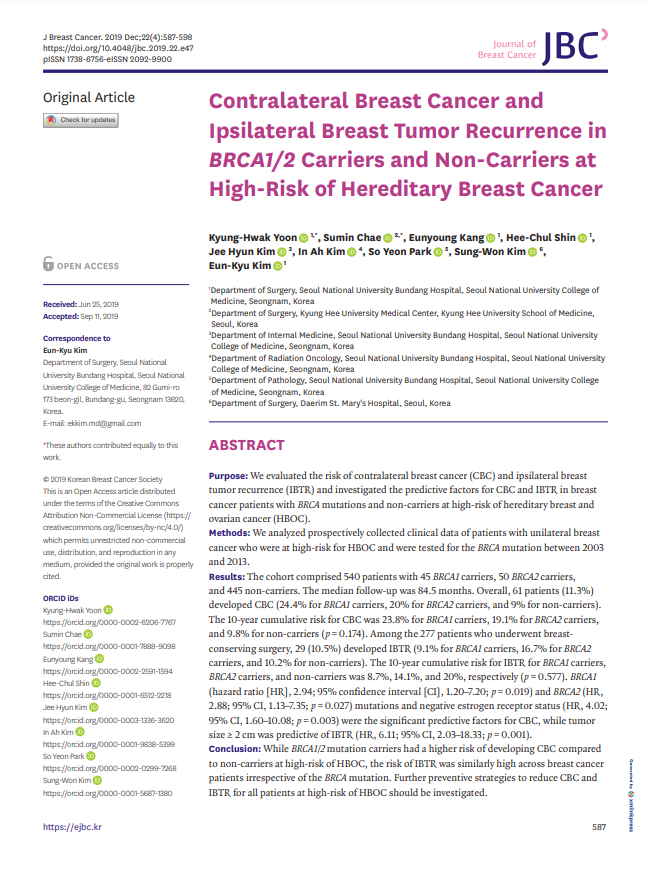 Contralateral Breast Cancer and Ipsilateral Breast Tumor Recurrence in BRCA1/2 Carriers and Non-Carriers at High-Risk of Hereditary Breast Cancer
-
 The functional ALDH2 polymorphism is associated with breast cancer risk: A pooled analysis from the Breast Cancer Association Consortium
-
 Height and body mass index as Modifiers of breast cancer risk in BRCA1/2 mutation carriers: A Mendelian randomization study
-
 Prevalence and oncologic outcomes of BRCA 1/2 mutations in unselected triple-negative breast cancer patients in Korea
-
 Development of a Management Algorithm for the Diagnosis of Cellular Fibroepithelial Lesions From Core Needle Biopsies
-
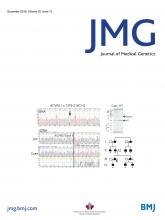 Reclassification of BRCA1 and BRCA2 variants of uncertain significance: a multifactorial analysis of multicentre prospective cohort
-
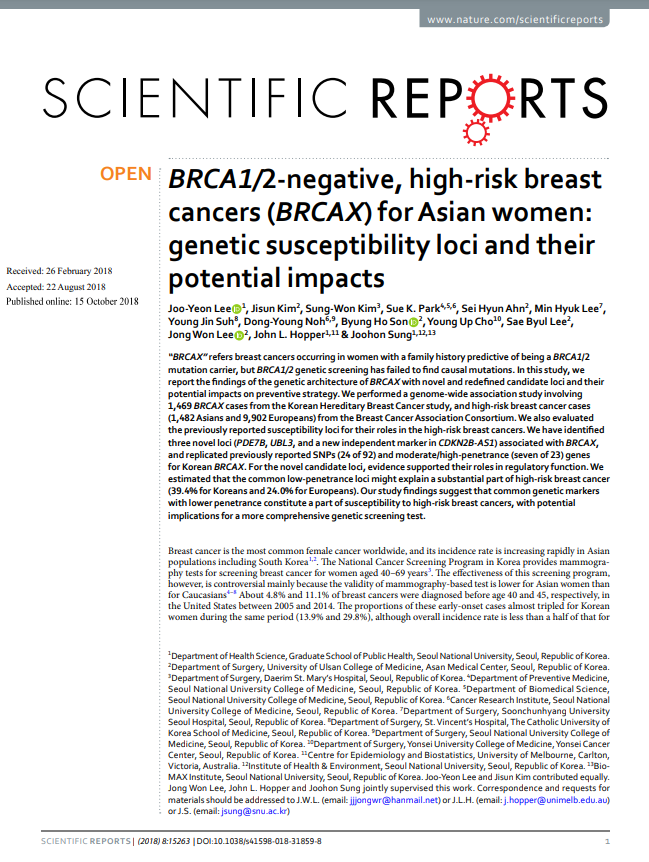 BRCA1/2-negative, high-risk breast cancers (BRCAX) for Asian women: genetic susceptibility loci and their potential impacts
-
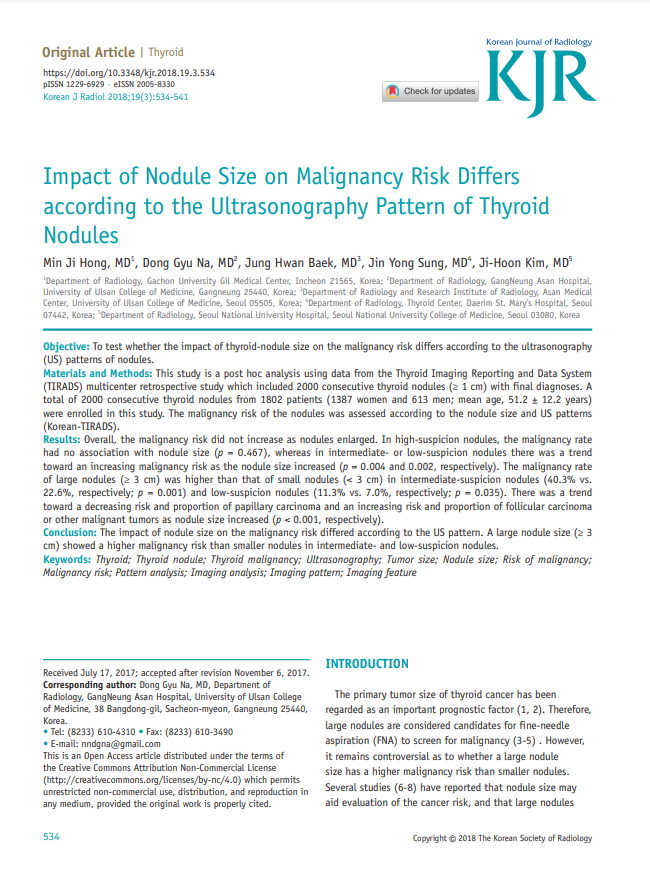 Impact of Nodule Size on Malignancy Risk Differs according to the Ultrasonography Pattern of Thyroid Nodules
-
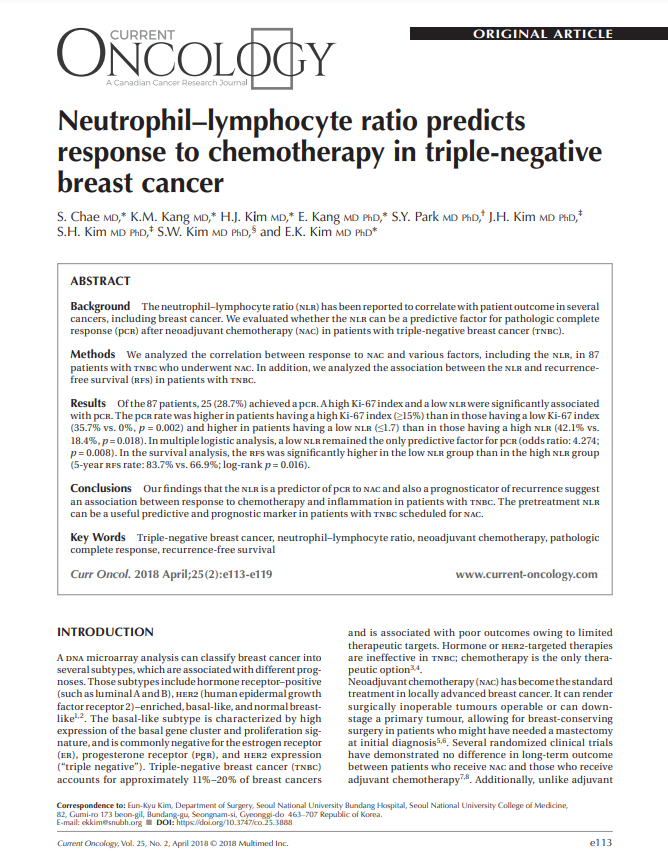 Neutrophil–lymphocyte ratio predicts response to chemotherapy in triple-negative breast cancer
-
 Identification of ten variants associated with risk of estrogen-receptor-negative breast cancer


