


-
-
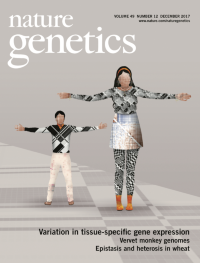
Nature Genetics Identification of ten variants associated with risk of estrogen-receptor-negative breast cancer 2017.12.12.Nat Genet. 2017 Dec; 49(12): 1767–1778. 논문 보기AbstractMost common breast cancer susceptibility variants have been identified through genome-wide association studies (GWAS) of predominantly estrogen receptor (ER)-positive disease1. We conducted a GWAS using 21,468 ER-negative cases and 100,594 controls combined with 18,908 BRCA1 mutation carriers (9,414 with breast cancer), all of European origin. We identified independent associations at P < 5 × 10⁻⁸ with ten variants at nine new loci. At P < 0.05, we replicated associations with 10 of 11 variants previously reported in ER-negative disease or BRCA1 mutation carrier GWAS and observed consistent associations with ER-negative disease for 105 susceptibility variants identified by other studies. These 125 variants explain approximately 16% of the familial risk of this breast cancer subtype. There was high genetic correlation (0.72) between risk of ER-negative breast cancer and breast cancer risk for BRCA1 mutation carriers. These findings may lead to improved risk prediction and inform further fine-mapping and functional work to better understand the biological basis of ER-negative breast cancer.
Total : 35개 (page : 2/3)
-
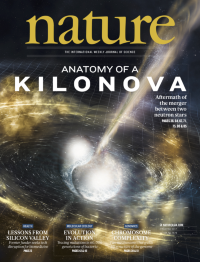 Association analysis identifies 65 new breast cancer risk loci
-
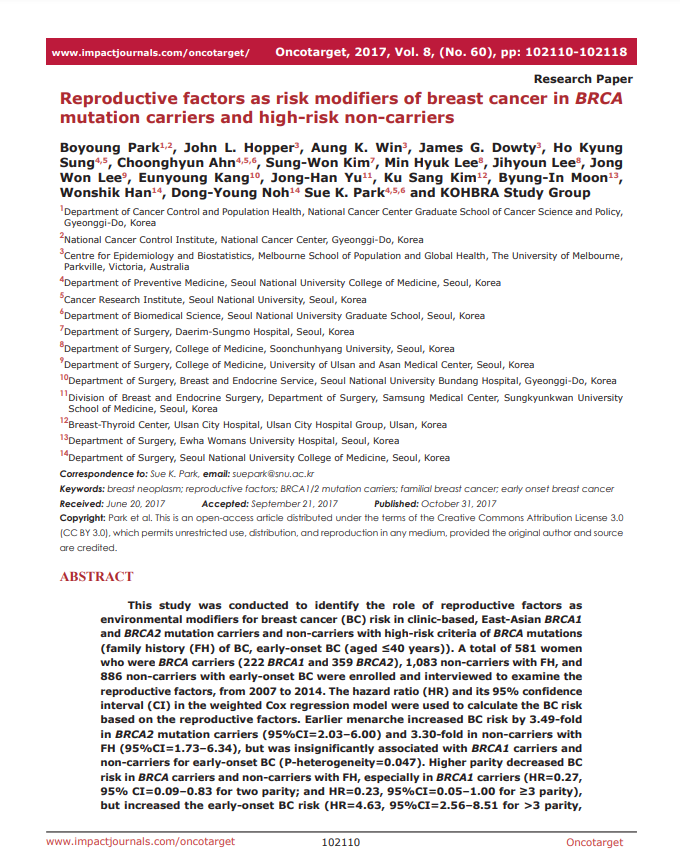 Reproductive factors as risk modifiers of breast cancer in BRCA mutation carriers and high risk
-
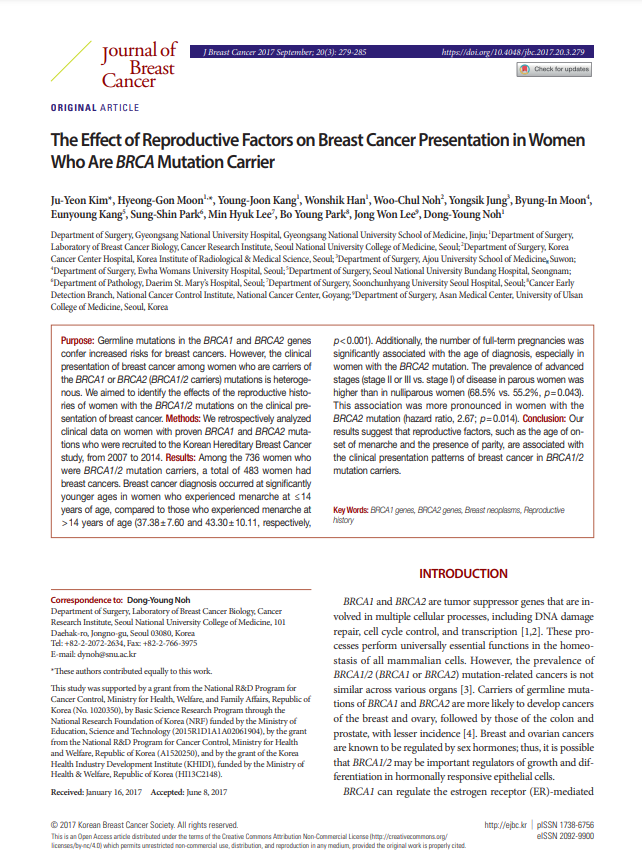 The Effect of Reproductive Factors on Breast Cancer Presentation in Women Who Are BRCA Mutation Carrier
-
 The Management Strategy of Benign Solitary Intraductal Papilloma on Breast Core Biopsy
-
 Prediction of Breast and Prostate Cancer Risks in Male BRCA1 and BRCA2 Mutation Carriers Using Polygenic Risk Scores
-
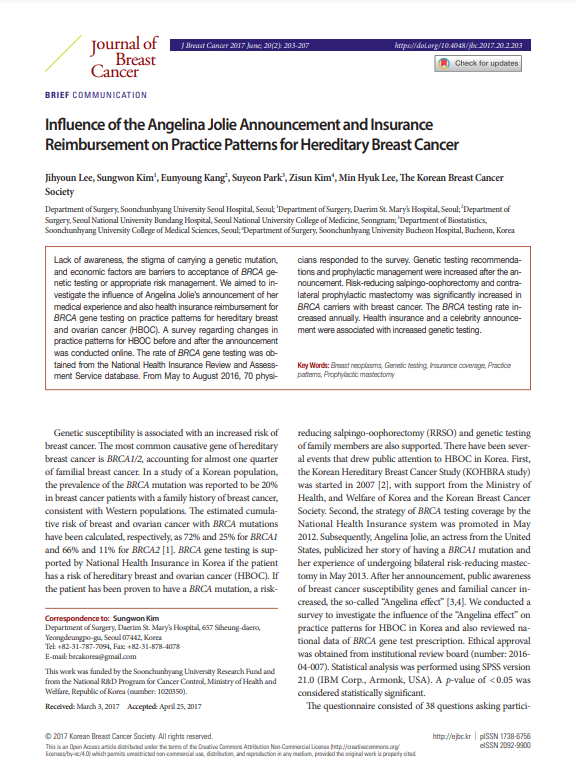 Influence of the Angelina Jolie Announcement and Insurance Reimbursement on Practice Patterns for Hereditary Breast Cancer
-
 Suggestion of BRCA1 c.5339T>C (p.L1780P) variant confer from 'unknown significance' to 'Likely pathogenic' based on clinical evidence in Korea
-
 Identification of 12 new susceptibility loci for different histotypes of epithelial ovarian cancer
-
 Failure patterns according to molecular subtype in patients with invasive breast cancer following postoperative adjuvant radiotherapy: long-term outcomes in contemporary clinical practice
-
 Association between basal-like phenotype and BRCA1/2 germline mutations in Korean breast cancer patients
-
 Use of a prospective surveillance model to prevent breast cancer treatment-related lymphedema: a single-center experience
-
 Reliability of Computer-Assisted Breast Density Estimation: Comparison of Interactive Thresholding, Semiautomated, and Fully Automated Methods
-
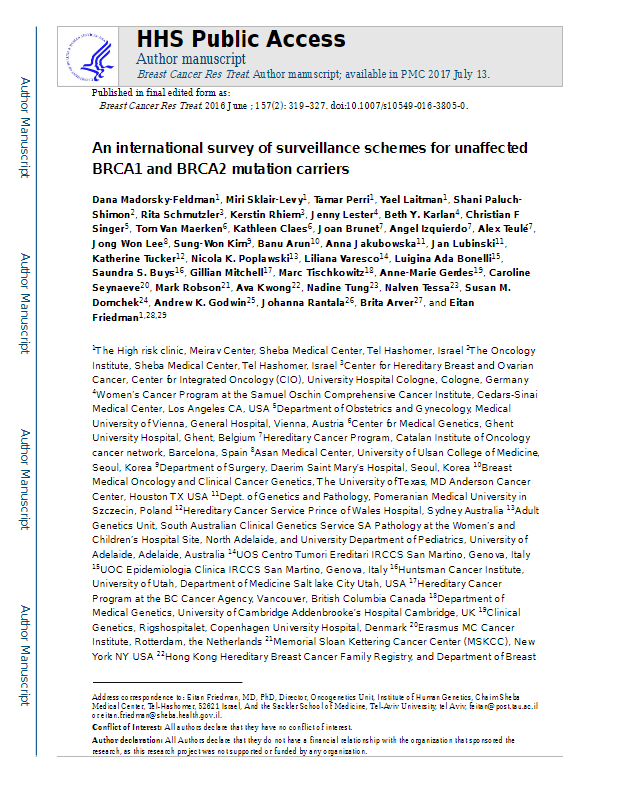 An international survey of surveillance schemes for unaffected BRCA1 and BRCA2 mutation carriers
-
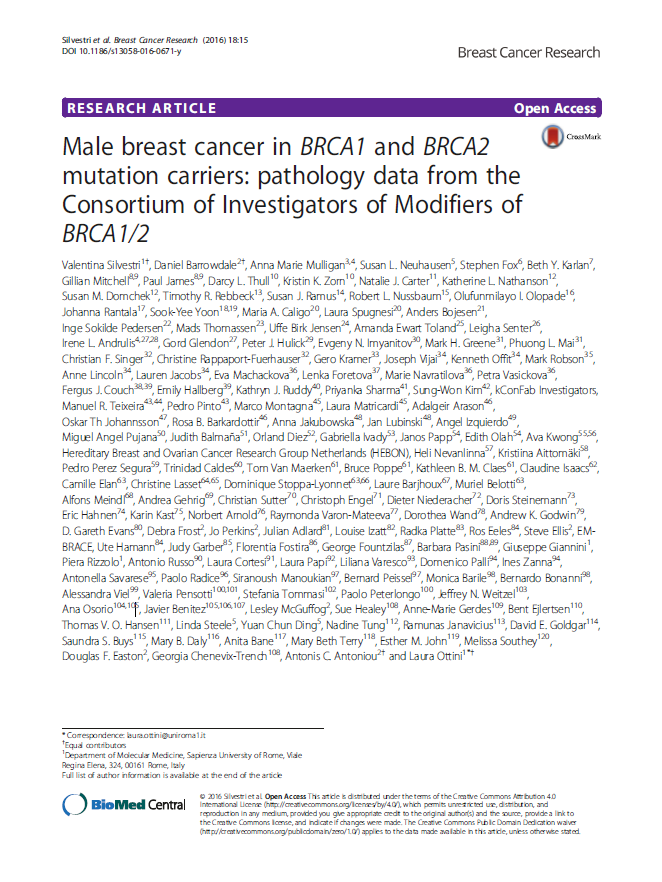 Male breast cancer in BRCA1 and BRCA2 mutation carriers: pathology data from the Consortium of Investigators of Modifiers of BRCA1/2
-
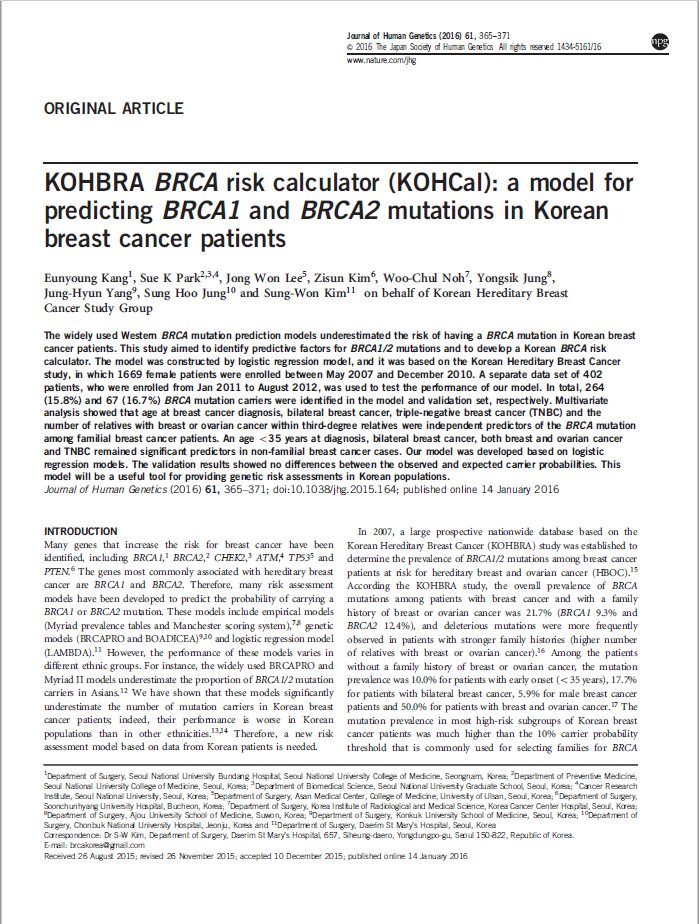 KOHBRA BRCA risk calculator (KOHCal): a model for predicting BRCA1 and BRCA2 mutations in Korean breast cancer patients


